This article by Chris Brown serves mainly to critique the views and theories of Paul Krugman. Krugman has an absurd idea that economic stability and the end of the current recession can be cured by a stimlus package. The crux of Krugman's argument is that in times of recession and economic hardship and new type of analysis must be adopted and traditional methods of alleviating economic downturns must be abandoned. Krugman argues that "depression economics" is the key to curing the slump, usual economic analysis becomes useless, "virtue becomes vice, caution is risky and prudence is folly". The author is quick to correct most of Krugman's arguments which are incorrect to say the least. The explanations and counter arguments presented in the article are quite effective and very interesting.
http://mises.org/story/3221
Sunday, November 30, 2008

Work Will Set You Free
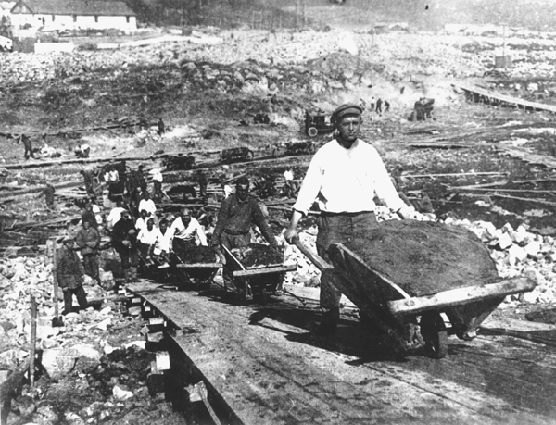
Archbishop Celestino Migliore is calling for an expansion of the public sector so that human dignity can be preserved. I wonder if this is anything like the "human dignity" that existed during the heyday of the Soviet Union?
*I just thought this was an interesting/ disturbing claim related to the financial crisis.
Injecting Failure
The "injections" into the financial system will not lead to an economic turn around, but they will lead to massive increases in the national debt. In September, the National Debt Clock in NYC ran out of digits as the figure ticked over $10 trillion. In this article Jim Puzzangherra states that:
"Interest rates remain low because of the crisis, but they will rise, particularly when the U.S. Government starts borrowing more money to cover its growing debt..[this] could cause inflation to increase as well."This is all just part of the "win-at-any-cost approach" that has been adopted by the current (as well as the future administration) in response to the "financial crisis".
These injections are demolishing the financial system because they are destroying the very forces that allow it to be effective. In doing this the government is also creating a mountain of debt that will eventually have to be paid off.
Wednesday, November 26, 2008
An Austrian Take on Recessions
In the article 'An Open Letter to Gary Becker re: Depressions', Robert P. Murphy explains why Austrian economists reject the current meddling with the market (especially during recessions) and explains how Gary Becker misunderstands Austrian theory.
He explains first "that the business cycle is an unintended consequence of government intervention in the monetary and banking system." He then gives a simplified analogy of the Austrian theory: "To adopt a biological metaphor: Of course nobody likes vomiting. But if someone has ingested poison, throwing it up is a good thing. Efforts by physicians to numb the person's gag reflex and settle his stomach will lead to disaster."
He then points out the flaws in Becker's blog post, later giving another metaphor, this time explaining what the current government actions are doing to the economy:
"Further "stimulus" efforts can postpone the recession, to be sure, but that just means that when it does hit, it will be all the more severe. Using fiscal and monetary policy to stave off an impending downturn is the economic analog of giving another fix of heroin to an addict in order to avoid the painful period of withdrawal. Such treatment isn't doing the patient a favor, and only ensures that the adjustment back to a sustainable lifestyle will be all the more difficult."
He goes on much longer and in much more detail on Austrian theory, misconceptions, and the current crisis.
Monday, November 24, 2008
Sunday, November 23, 2008
Forgotten Lessons
The article, Business Cycles, Not Our Fault, makes mention of the fact that people have not learned from their past mistakes. The mistakes the article is discussing is that of the current plans for bailouts. People blame the current crisis on greedy capitalists or financial deregulation but fail to realize that these bailouts will further exacerbate the problem. There have been many lessons throughout the early 20th century given by world renowned economic thinkers and their teachings have been discarded and replaced by flawed methods of thinking government intervention, protectionism and other such ridiculous policies.
This is an article about the loss of business in the restaurant industry. This signifies that we are indeed in a bad recession. this is an interesting article because it explains what the restaurants are going to do to stay in the black during these hard times.
http://www.nytimes.com/2008/11/16/fashion/16consumption.html?ref=economy
http://www.nytimes.com/2008/11/16/fashion/16consumption.html?ref=economy
Japan’s Economy, World’s Second Largest, Is in Recession
This article written in the NY times on nov. 16 by Martin Fackler is all about what it means when the second largest economy in the world goes into recession. the Article also compares Europe's recession to the rest of the world and what impact it has. This article basically states how bad the world economy is.
http://www.nytimes.com/2008/11/17/business/worldbusiness/17yen.html?ref=economy
http://www.nytimes.com/2008/11/17/business/worldbusiness/17yen.html?ref=economy
Citigroup Plans to Sell Assets and Cut More Jobs
This article is about the downsizing that Citigroup is planning on instituting. This is a huge statement since according to the article Citigroup is already outsourcing over 23,000 jobs to India and Germany. The article was written by Eric dash and was published in the NY Times on Nov. 17.
The article goes on to talk about what this means relative to the rest of the investment banks that are also in trouble.
http://www.nytimes.com/2008/11/18/business/18citi.html?ref=business
The article goes on to talk about what this means relative to the rest of the investment banks that are also in trouble.
http://www.nytimes.com/2008/11/18/business/18citi.html?ref=business
"Entreprendre" means "To Undertake"
The role of the entrepreneur remains to be of paramount value to the resilience of the US economy. Amidst the current financial crisis, the landscape has shifted tremendously for entrepreneurial activity. The Global Entrepreneurship Monitor (GEM) is a research program that compiles statistical data to create an annual assessment of the national level of entrepreneurial activity in specific countries. Their methods of collecting data include global comparisons, national reports, and special topic reports based on their annual cycle. Despite the overwhelmingly regurgitated use of the word "entrepreneur" in their assessment (that makes you almost car sick), it is worth taking a look at some of the current trends and motions their data has been showing, here is their latest report on the United States for 2006-2007.
Saturday, November 22, 2008
Bush attempts to rally calls to free trade, stifles yawn.
In what might (hopefully) become his final international address, Mr. Bush lauded the importance of international free trade. While describing the benefits, in the same speech Pres. Bush warned about the dangers that a deregulated economy could bring and also raised calls for more government intervention. While the call for a greater understanding and adoption of free trade is justifiable, the ignorance in asking for it while introducing the concept of greater government regulation in the economy is not.
http://online.wsj.com/article/SB122736599036150771.html
http://online.wsj.com/article/SB122736599036150771.html
Friday, November 21, 2008
Financial System Suffers Relapse
This article by Neil Irwin and Renae Merle, addresses how after a slight improvement in the financial system, it is all unraveling again. Many investors are moving their money to U.S. Treasury debt where it will be safer. The market has hit its lowest level since 1997 and financial companies are being hit especially hard. Citigroup shares lost half their value this week, something truly alarming considering their importance in the financial industry. The broader economic picture also darkened last week as more americans filed for unemployment insurance benefits than any other week since 1992.
Thursday, November 20, 2008
You Go Girl! The Wisdom of Michele Bachmann
It's not often that you hear members of congress straight-talking on the issues. However, during yesterday's hearing for the House Financial Services Committee, Minnesota congresswoman Michele Bachmann released an extremely candid statement about her views on the proposed bailout of the automobile industry.
In her statement, Bachmann vehemently opposed the bailout on the grounds that the American taxpayers simply can't afford to keep these failing companies afloat. For years the auto companies have been becoming progressively less competitive in the world market, so bailing them out would simply be sanctioning their poor business practices - and sanctioning them at the expense of the taxpayer.
Bachmann enumerates the taxpayers current bailout tab:
$29 billion for Bear Stearns, $200 billion for Fannie and Freddie, $300 billion to expand the
Federal Housing Administration (FHA), $150 billion for AIG, and $700 billion for the Paulson
Plan -- plus $110 billion in sweeteners to pass that plan.
Since American taxpayers are already overwhelmed with subsidizing these companies, piling another burden on them would have disastrous effects.
The New Domino Effect
In the article 'Pass the Plate', the differences between the U.S. and European auto-bailout situations are discussed. In regards to the Big Three, their economic situation is much more serious than those auto companies in Europe. While GM claims to be in dire need of the bailout, Ford seems like it will be able to survive for a longer amount of time - unless of course GM does go under, impacting parts suppliers. In Europe, auto companies are doing much better (still not exactly good), but still wish for a bailout, or subsidies rather, for the harsh carbon dioxide emission regulations that will go in effect by 2012. German manufacturers, producing cars that will be most effected by these regulations, are in favor of the bailout; while French and Italian auto companies (who will not be as effected by these new rules) do not feel a subsidy from taxpayers is necessary when benefiting a portion of the auto industry.
In any case, Europe will be waiting to react. The European Investment Bank will consider bailouts more seriously after seeing what happens in Detroit; if the auto-bailout does occur here, there is a good chance the 'bailout-plate' will be passed to Europe.
With all these bailouts occurring, a new domino effect is emerging. Bear Stearns fell, then Fannie Mae and Freddie Mac, then American International Group, then the $700 Billion bailout, then the UK rescue package. Now the auto-bailout dominoes are quivering.
Sunday, November 16, 2008
Same As History?
The article Don’t Bail Them Out, by Llewellyn H. Rockwell, Jr., is addressing the reasons for why we should not bailout companies or business that put themselves in situations that lead to their own crisis. Rockwell also goes into addressing about how the Great Depression would have, at most, lasted 18 months but instead it lasted 16 years because the government decided to help bailout the companies and business that affected the stock market. He predicts that this would be the same outcome if the government tries to help these companies, such as Freddie and Fannie, by giving them money to help them out. There is one paragraph in the article that I believe summarizes what Rockwell has to say. “What should have happened in 1929 is precisely what should happen now. Let the price system prevail! The government should completely remove itself from the course of action and let the market reevaluate resource values. That means bankruptcies, yes. That means bank closures, yes. But these are part of the capitalistic system. They are part of the free-market economy. What is regrettable is not the readjustment process, but that the process was ever made necessary by the preceding interventions.”
US Auto Market
This article was about the current financial crisis and its effect on the auto industry. Auto industries are a major part of the economy and the bankruptcy of the American automakers would devastate the economy. General Motors is asking for a $25 billion dollar loan in order to make assets more liquid and get through these rough times. Seeing how the market ha yet to bottom out, some people predict the recession may continue well into the coming year.
http://www.reuters.com/article/ousiv/idUSTRE4AF1W920081116
http://www.reuters.com/article/ousiv/idUSTRE4AF1W920081116
Friday, November 14, 2008
As the status of the finacial crisis fluctuates, Paulson rethinks strategy
In a form insight into what amounts to crisis control for the United States, Treasury Secretary Hank Paulson, announced plans to refit the Treasury's strategy to help solve the economic crisis. The fact that the change was announced is nothing new; such announcements that pronounce a change to fix the current financial crisis are indeed common. However, as Paulson himself has said, that such changes are indeed neccassary as the extent of the damage and the scope of neccessary repairs become more evident. In some cases, Secretary Paulson has been accused for not acting quicker in responding the dynamic nature of the crisis, referring to the delay in the recapitalization of certain finacial instututions that the government has agreed to assist.
In some cases, Mr. Paulsons tempid attitude to a quick reaction to the crisis is well warrented. By not rushing into the scene and taking a step back to reassess the environment, the government is able to ensure that the plan can be executed as well as possible.
One prime example of this is the limited response to the American Auto industry. Unlike the banks, the US auto firms were already in touble before the economic crisis, and with the loans that some in the government are proposing as well as president elect Barak Obama, the gaurentee that these loans will be paid back to the gov. in the future is limited. http://www.economist.com/world/unitedstates/displayStory.cfm?story_id=12597500&source=features_box3
Granting Immortality
After briefly discussing F.A. Hayek's ideas (from Law, Legislation, and Liberty) in class today (Nov.14,08') about political culture, democracy, and negative long-term effects of the bailout, I found this recent article by David Brooks relevant. Brooks describes Obama's plans for the Big Three Automobile companies as "the creation of an auto czar with vague duties" and that the larger principle is, in fact, over "the nature of America’s political system." Democrats from Barack Obama to Nancy Pelosi want to grant immortality to General Motors, Chrysler and Ford. They have decided to follow an earlier $25 billion loan with a $50 billion bailout, which would inevitably be followed by more billions later...Simply put, bad behavior is rewarded, concentrated benefits to the few at the expense of our tax dollars, and capital that could have gone to successful companies and programs will be directed toward companies with a history of using it badly.
Bankruptcy is the least horrible option.
Bankruptcy is the least horrible option.
The threat of deflation
The name of the article is called The threat of deflation and it goes into detail about how the theory of spending among people in the world economy. Thanks to the fall in oil prices the economists expect for consumer prices to fall up to 2.5 percent. It seems as if prices in different markets will fall as a result but central banks would prefer that they fall at a steady pace as opposed to a large initial decrease because falling prices make debt much more expensive. Also, the United States has a reason to look forward to the summer as inflation prices are expected to be negative by July. This was a very interesting article because it shows the psychology behind the spending and addresses what the state of the economy will be once prices fall.
http://www.economist.com/finance/displayStory.cfm?source=hptextfeature&story_id=12607235
http://www.economist.com/finance/displayStory.cfm?source=hptextfeature&story_id=12607235
Feeding Frenzy: Rent Seeking on Capitol Hill
A November 11 article for the New York Times could be used as a textbook example of rent seeking.
Since the passage of the first bailout plan, lobbyist groups have been flooding the treasury with requests that they too receive a piece of the federal pie. Groups such as the National Marine Manufacturers Association find it unfair that the government is only allocating money to certain interests while arbitrarily ignoring other struggling businesses. Obviously, the government can't just give handouts to every business that has been hit by the financial crisis - yet this situation might cause one to wonder how the government, without being able to draw information from the price system, chooses which interests it thinks worthy of helping and which it does not.
Furthermore, the government is using my tax dollars to help prop up businesses they deem worthy. I have no say in whether I think the businesses should be given money or not. The whole system seems not only arbitrary then, but also unjust to the taxpayers.
Toward a New International Capitalism
This article by Steven Pearlstein addresses the decisiveness of the financial crisis and how it is the most important moment in American Capitalism since 1944, when leaders of 44 nations came up with a blueprint for a new world financial order based on principles of free market, free trade and the free flow of capital. In recent years the US has gone from being the world's largest creditor to being the world's largest debtor and can no longer expect to dominate the international financial institutions. The current crisis in America has contributed to global instability, proves that the current unregulated US system has many flaws and does not necessarily produce the best outcome.
Thursday, November 13, 2008
Another Bailout and the 'Money Hole'
Now an auto industry bailout for the 'Big Three' - General Motors, Ford, and Chrysler - is being discussed by congressmen. In this article, the lack of Republican votes in Senate is expected to cause the bailout to fail.
On the topic of increases in government spending, this video from The Onion features comedians discussing the need for the U.S. government 'Money Hole.' According to these experts, it would be 'alarmist and irresponsible' to talk about closing the National Money Hole. The creation of private money holes is another option discussed. In any case, it will at least make you laugh.
"If you love America, you throw money in its hole!"
Friday, November 7, 2008
R.I.P. European Free Market? The Evolution of Government intervention in its markets.
On October 30, the Economist posted an article (http://www.economist.com/world/europe/displayStory.cfm?story_id=12510261) proclaiming the looming danger of European governments response to the looming recession that is rapidly becoming more widespread across global markets. The dangerous response in question was that regarding the notion that a greater form of government control and regulation over what is already seen as a somewhat recognized socialist style market system. Some European governments have institutionalized many important commodities such as healthcare, and now many European leaders are taking the viewpoint that this new crisis is a sign that the economy is not regulated enough. While it is not surprising that some nations have adopted this notion, such as France, a notable advocate to a more government regulated economic system, others have comletely reversed their stance. One example of this is Italy's prime minister, Silvio Berlusconi, a former communications tycoon and former staunch advocate of a deregulated economy, has completly done an about-face on his position and is now standing with French President Sarkozy on the idea that more government regulation is now the best solution to fix this crisis. That is not to say that all European leaders agree with this idea. Germany's economic minister, Michael Glos, has made several statements warning that this idea could be even more catastrophic to the economy. As the economist magazine editor notes that history shows that state run industries often fail to match their purpose of existence and might even backlash.
I think that it is vital that European leaders rethink any strategy they might have to revamp the eocnomy via government regualtion and rule in favor instead of further de-regulating the economy, away from government control. The magazine has another point, that while politicians may accuse the symbolic corporate "fat cat" for the cause of the crisis, and that politicians themselves portray themselves as saviors, the politician's motives may also be in league with that of the corporations themselves rather than the public interest. What do you think?
I think that it is vital that European leaders rethink any strategy they might have to revamp the eocnomy via government regualtion and rule in favor instead of further de-regulating the economy, away from government control. The magazine has another point, that while politicians may accuse the symbolic corporate "fat cat" for the cause of the crisis, and that politicians themselves portray themselves as saviors, the politician's motives may also be in league with that of the corporations themselves rather than the public interest. What do you think?
Beyond Crisis Management.
When there is a crisis there are many debates of what measures need to be done to correct the problems. There is usually is a battle between tacticians and strategists. The tacticians dash from skirmish to skirmish trying to control a crisis, deciding in each case whether taxpayers should bail out a distressed bank, firm or country. The strategists call for a more comprehensive approach to resolving the mess—often involving new government bodies to recapitalise banks or take over troubled assets. It seems as if there are two different philosophies and the tacticians seem like they are more so respnsible for the huge bailouts we have become familiar with. The article goes on with showing us what strategies need to be implemented to smoothen the financial crisis the corporations have dug us into. The article is called Beyond Crisis Managment and is very intuitive because it shows the financial side of the economy. http://www.economist.com/finance/economicsfocus/displaystory.cfm?story_id=12262103
The Green Span
Was Alan Greenspan's Fed "innocent of any role in encouraging the housing boom" and did he actually manage to "solve the monetary-central-planning problem" ?
A briefing paper from the CATO institute by David R. Henderson and Jeffrey Hummel has posed a challenge to those who insist that a persistently sound central-banking policy is not only unlikely but beyond what Selgin argues, the "ken of mere mortals, and that even the best of possible central bankers must eventually steer the economy he is piloting into disaster." They pose an eloquent defense of Alan Greenspan and his FED. Out of the many recent critiques of the paper in blogs and articles, Selgin does a thorough job in evaluating the problems with some of their claims,he gives insight into the Monetary Misunderstandings and logic of the Housing Boom and Fed Policy. However in conclusion, he says that it is a valuable service not just to Greenspan himself but to monetary economics- surely a paper that has caused some recent debate.
A briefing paper from the CATO institute by David R. Henderson and Jeffrey Hummel has posed a challenge to those who insist that a persistently sound central-banking policy is not only unlikely but beyond what Selgin argues, the "ken of mere mortals, and that even the best of possible central bankers must eventually steer the economy he is piloting into disaster." They pose an eloquent defense of Alan Greenspan and his FED. Out of the many recent critiques of the paper in blogs and articles, Selgin does a thorough job in evaluating the problems with some of their claims,he gives insight into the Monetary Misunderstandings and logic of the Housing Boom and Fed Policy. However in conclusion, he says that it is a valuable service not just to Greenspan himself but to monetary economics- surely a paper that has caused some recent debate.
Thursday, November 6, 2008
Was the Origin of the Central Bank Corrupt?
The article “The Corrupt Origins of Central Banking”, written by Thomas J. DiLorenzo, is about original foundation of the corrupt central bank. The article addresses Robert Morris as the person who desired to establish the American version of the British mercantilist system. The article further addresses Morris’s desire "to organize and head a central bank, to provide cheap credit and expanded money for himself and his allies.” Alexander Hamilton is suggested as helping Morris in his schemes. The article concludes by stating how the method of Morris and Hamilton failed to function because it violated primary American rights, which are liberty alongside prosperity. It is a very interesting article to read.
Wednesday, November 5, 2008
Fifth of November Irony
Today commemorates the 403rd anniversary of Guy Fawkes' attempt to blow up the British parliament. Though today he is considered a villain for attempting to subvert the British authority, his resistance of coercive power has recently gained him a heroic reputation amongst libertarians and other anti-authoritarian factions. The 2005 movie V for Vendetta even makes Fawkes into a symbol of resistance to oppressive rule, saying that "people should not be afraid of their governments, governments should be afraid of their people."
To learn more about this unlikely hero, check out this article from today's Time. Ironically, Fawkes was a last-minute add to this plot, yet his is the personality most remembered in connection to what has become to be known as the "Gunpowder Treason." Even more ironic, however, is the fact that this year, the holiday takes place the day after the election of our new president - a man who has promised to institute a plethora of new "egalitarian" measures. Yet in trying to promote equality, he will effectively be denying some individuals of their hard-earned property in order to redistribute it to those who did not work to earn said property. This idea of "egalitarianism" sounds just a little unjust to me...
To learn more about this unlikely hero, check out this article from today's Time. Ironically, Fawkes was a last-minute add to this plot, yet his is the personality most remembered in connection to what has become to be known as the "Gunpowder Treason." Even more ironic, however, is the fact that this year, the holiday takes place the day after the election of our new president - a man who has promised to institute a plethora of new "egalitarian" measures. Yet in trying to promote equality, he will effectively be denying some individuals of their hard-earned property in order to redistribute it to those who did not work to earn said property. This idea of "egalitarianism" sounds just a little unjust to me...
A Word on Obama's Brilliant Spending Proposals
With the economy in shambles, President Elect Barack Obama has a great plan to fix our fiscal problems: more federal spending (hint my intended sarcasm). Among other items on his agenda, Obama plans to sink at least $15 billion into renewable energy research, which he says will create 5 million new jobs, and to put upwards of $50 billion per year into a universal health care plan (with some independent estimates offering much higher figures). According to an article in this morning's LA times, however, the first bills Obama will likely pass will be those which will gain overwhelming support from both parties - showing the world that this young senator from Illinois is really ready to be the nation's leader. Yet with the financial system in such a shaky condition, Obama must be extremely careful with how much federal money he spends, for the article warns that if the federal budget deficit reaches a trillion dollars, this will likely send the economy into an even worse shock than the one we recently experienced.
Monday, November 3, 2008
Stimulus Packages and Bailouts around the World
In the article 'Overseas, More Nations Assemble Stimulus Plan', authors Burnett and Wassener describes the stimulus plans being organized in Australia, where interest rates are being lowered, South Korea, where a $10.9 billion stimulus package is being constructed, and Spain, where complex mortgage payment plans are forming.
In the article 'German Bank Seeks $10.5 Billion in Bailout Aid', author David Jolly highlights the German bank, Commerzbank, asking the government for a bailout. He also describes the trouble a French bank is having with business.
In the article 'German Bank Seeks $10.5 Billion in Bailout Aid', author David Jolly highlights the German bank, Commerzbank, asking the government for a bailout. He also describes the trouble a French bank is having with business.
Quantitiative Easing??
In the article, A Rate of Zero Percent From the Fed? Some Analysts Say It Could Be Coming, author Edmund L. Andrews claims that in order for the Fed to spark up the economy, it might have to set the target federal funds rate at 0 %.
A government induced zero interest rate would be odd enough; banks loaning to one another overnight for zero-interest because of the free-market equilibrium rate would be even weirder, and Andrews claims that rates might be close to that.
What the Fed is really focusing on is expanding the money supply of course. If and when they do reach the zero mark, Bernanke claims that they will buy up Treasury securities with longer maturities, then privately-issued debt if that didn't work.
"In effect, the Federal Reserve would be printing more money and injecting it into the economy — a strategy of 'quantitative easing,' in Fed jargon."
Great.
Bubble
In the article, Was There a Loan It Didn't Like?, Gretchen Morgenson interviews mortgage underwriters at WaMu.
The underwriters were repeatedly pressured to 'restructure' subprime loans: they were offered paid vacations when they reached certain loan amounts and threatened with "letters of complaint" in personal files for rejecting loans.
Although the article does not delve into why WaMu would ever endorse such heinous acts, I wonder if the government had anything to do with it... The Community Reinvestment Act and similar legislation could be to blame..
http://www.bloomberg.com/apps/news?pid=20601087&sid=aLx_ufXAnIqE&refer=home
The U.S. Treasury more than tripled its planned debt sales for this quarter to help finance a 2009 budget deficit that bond dealers advising the department estimate may swell to almost $1 trillion. The sale of debt would hope to thaw the frozen credit market. This increase in the projected deficit has been icing on a cake of financial turmoil.
http://www.bloomberg.com/apps/news?pid=20601087&sid=aLx_ufXAnIqE&refer=home
http://www.bloomberg.com/apps/news?pid=20601087&sid=aLx_ufXAnIqE&refer=home
Subscribe to:
Posts (Atom)